Choose first player
Each player rolls two dice. The higher total chooses whether to act first or second; reroll ties.



Learn Wardom: Sword and Shield
New to the realm? Start with the essentials, walk through your first round, then keep the rules reference close at hand.
Before round one
Each player rolls two dice. The higher total chooses whether to act first or second; reroll ties.
Each player begins at 20 resolve, draws 5 cards, and starts with 5 maximum energy and 5 available energy.
Your battlefield runs Combat first, Support second, then the Wager/Coin zone. Three Action slots, the shared Field, a 3-card Side Zone, Treasury, void, and Forbidden Zone sit alongside it.
Win battles to deal resolve damage and claim wagers. A player loses when their resolve reaches 0, or when they are required to wager and cannot provide a legal card.
Round flow
Resolve start-of-turn effects and prepare the board. The opening setup happens before the first Resource Stage.
Refill energy to your current maximum. Except for the first player on round one, draw until you hold 5 cards; if you already have 5 or more, draw 1 instead. Pay Field upkeep and resolve Resource effects.
Recruit Units, play or set Actions, play a Field, activate legal effects, and place a wager before you leave the stage.
Reveal set Units in turn order, build any response sequences, compare the two formations, deal resolve damage, destroy a front-line Unit when eligible, and coin the losing wager.
Resolve end effects. The winner routes Units to the Side Zone first, then the loser. Increase maximum energy by 1, up to 10, and swap who acts first next round.
The first player takes Start, Resource, and Main; then the second player takes Start, Resource, and Main. Both players then resolve Battle and End & Routing.
Energy refreshes to your current maximum in Resource. Maximum energy starts at 5 and rises by 1 after each round, to a cap of 10.
Claimed wagers become spendable coins. A Treasury card pays its full printed value; excess value is not returned as change, and the spent card enters the Forbidden Zone.
You must control a legal wager before leaving your Main Stage. Placing a card in the Coin Zone is free; True Recruit Units cannot be wagers.
Keep up to 3 Units in your Side Zone and up to 3 cards in your Action Zone. At End Stage, discard down to 8 cards in hand.

Battle calculation
Reveal. The first player flips set Units, then the second player. Resolve triggers and response sequences.
Total the formation. Add all face-up Combat values for your Combat total and all face-up Support values for your Support total. Combat + Support is your Battle total.
Choose the winner. The higher Battle total wins. A tie deals no resolve damage and claims no wager.
Deal resolve damage. Winner’s Combat minus loser’s Support, minimum 0. Piercing ignores the loser’s Support.
Destroy and coin. If winner’s Combat is greater than the eligible front-line Unit’s relevant stat, destroy it unless protected. Then the losing wager is coined by the winner.
Cards and timing
Parenthetical zone labels tell you where an effect is active. A written cost before a colon must be paid before its effect can resolve.
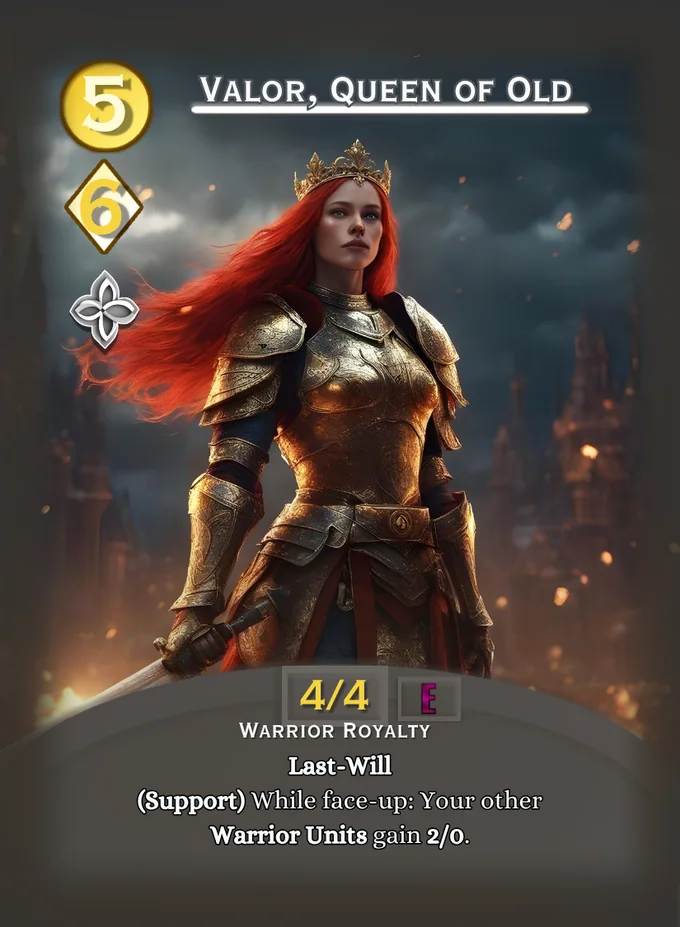
Has Combat/Support stats, a level, element, types, and zone-based effects. Units are normally recruited from the hand or Side Zone.
Normally activated during your Main Stage, then sent to the void after resolving unless its text says otherwise.
Can respond during eligible Resource or Main windows, and can be activated from a set Action Zone during any stage.
Must remain set for a full round and meet its condition. Its cost may be paid with energy, treasury, resolve, or a legal combination stated by the card.
Remains face-up after activation and can continue applying or activating its effect, subject to printed limits.
Attaches to a Unit and remains with it, granting the printed bonuses or statuses.
Occupies the shared Field Zone. A new Field must meet the replacement-cost rule; its upkeep is paid during Resource or it is sent to the void. Text marked Rule affects both players.
Enters the pouch/Treasury when its requirement is met. Its printed cost is the coin value gained, not a cost paid to play it.
An effect targets a card only if its text explicitly uses the word “target”. A card with Stealth is not a legal target for that effect. If the effect instead selects or chooses a card without saying “target”, Stealth does not prevent that selection or the effect. All other restrictions still apply.
Example: Chaggai, Joker of Old selects a card but does not say “target”, so its effect can select a card with Stealth. By contrast, an effect that says “target 1 Unit” cannot target a Unit with Stealth.
True Recruiting
A cost of 0 does not make a True Recruit Unit an ordinary free recruit. Follow these steps during your Main Stage.
Resolving a sequence
Status reference
Statuses apply only to face-up Units unless a card says otherwise. Cleanse removes statuses and stat changes; Pure also blocks new statuses.
Keyword reference
Card text overrides the general rule when it is more specific. If a printed term has no published definition, do not invent an effect; use the written card text and the latest official Wardom ruling.